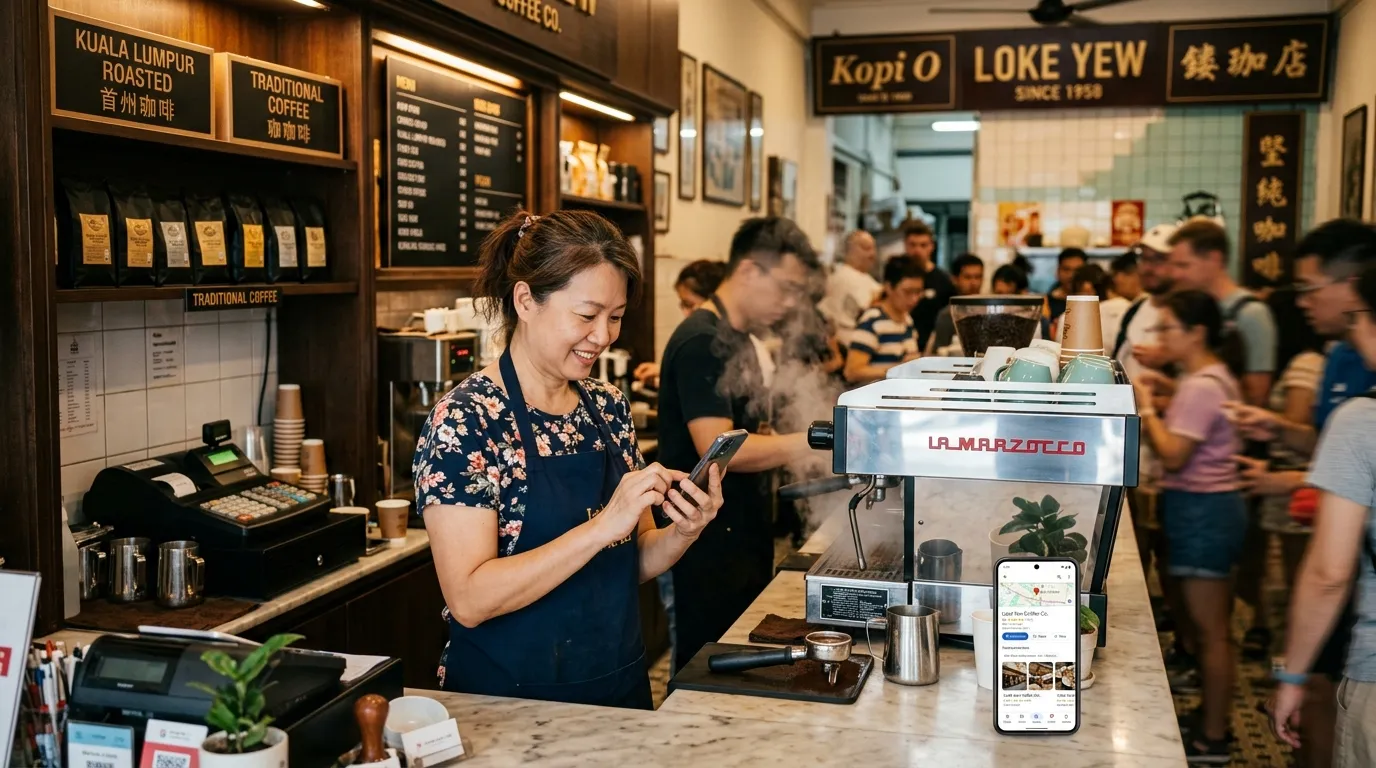
Two decades ago, a business owner in Kuala Lumpur had to rely solely on street signage and word-of-mouth to attract new customers. Today, a small business in the town of Temerloh can be discovered by thousands of potential customers simply because of a single digital listing on Google Maps. The journey of Google Maps in Malaysia — from an incomplete digital map to a decider of local business survival — is a story of transformation that is still being written.
2005: The Birth of Google Maps and Malaysia's Absence From the Digital Map of the World
Google Maps was officially launched on 8 February 2005, initially covering only the United States and Canada. At that time, Malaysia was virtually non-existent in this global digital mapping ecosystem. Local businesses in the Klang Valley or in Johor Bahru had no presence whatsoever in a system that was already changing how the world reads physical space.
The early expansion phase of Google Maps focused on Western markets, and Southeast Asia was treated as a secondary region. Malaysia at the time still depended on local mapping software such as MapKing and printed maps from the Department of Survey and Mapping Malaysia (JUPEM). This digital gap was not merely an inconvenience — it meant that Malaysian businesses could not be indexed, could not be found, and could not compete in an increasingly important digital space.
2007–2010: Malaysia Begins to Appear on the Map
Between 2007 and 2010, Google began expanding its Street View coverage and map data to the Asia Pacific region. Malaysia received basic Google Maps coverage during this period, although road data and Points of Interest were still far from complete. Major cities such as Kuala Lumpur, Georgetown, and Johor Bahru began to appear with greater clarity, but rural areas and small towns remained patchy in the digital record.
Google Street View Malaysia was officially launched in 2012, starting with the Klang Valley and Penang areas. This means that for the first seven years of its existence, Google Maps could not show the 'real look' of Malaysia's streets to users around the world.
2012–2016: The Google My Business Era and the Local Business Revolution
The most significant turning point came not on the map itself, but in the business layer placed on top of it. Google launched Google My Business (GMB) in 2014 — a platform that allowed business owners to claim, verify, and manage their digital presence directly on Google Maps. For the first time, a restaurant in Ipoh, a boutique in Ampang, or a workshop in Seremban could provide their operational information to the world's largest search engine.
For Malaysian SMEs, this was a true game-changer moment. Businesses that were previously invisible in 'near me' searches could now appear directly in front of potential customers who were actively looking for their services. But the hard reality was this: many Malaysian business owners at the time were still unaware of the importance of this simple step, and their business listings were left incomplete or entirely unclaimed.
“Google My Business is not merely an online directory. It is the fundamental digital infrastructure that determines whether your business exists in the eyes of 21st-century customers.
— Editorial Perspective, GBP Audit Lab
2018–2021: The Pandemic Forces Malaysian SMEs to Acknowledge the Importance of Google Maps
If there was one event that accelerated Malaysian SMEs' awareness of the importance of digital presence, it was the Movement Control Order (MCO) that began in March 2020. With physical shops closed, customers turned entirely to online search to find businesses that were still operating, offering delivery, or reopening. Google Maps quickly became the most sought-after digital noticeboard — and businesses without a complete or up-to-date listing lost countless sales opportunities.
Google itself responded by introducing pandemic-specific features, including a 'Temporarily Closed' option, special operating hours updates, and a 'Delivery Available' attribute. For Malaysian SMEs that had already claimed their Google Business Profile (GBP), these features became critical business survival tools. For those who had not, the digital gap finally showed its consequences.
2022–Present: Google Business Profile and the Era of Competitive Visibility
In November 2021, Google My Business was officially rebranded as Google Business Profile (GBP), reflecting the expansion of its functionality well beyond a simple map listing. GBP is now not just a space to display an address and phone number — it is a business profile that brings together customer reviews, product photos, latest posts, Q&As, direct bookings, and a range of other attributes that influence purchasing decisions.
In the context of local search marketing, GBP's influence on rankings in the 'Local Pack' — the top three listings that appear when users search for nearby services — has become increasingly dominant. Studies have found that GBP signals contribute a significant portion of local search ranking factors, making profile optimisation not merely a best practice but a basic competitive necessity.
What Has Changed in the Google Maps Malaysia Algorithm
- Relevance: How closely your GBP profile matches what users are searching for — your business name, category, and description all play a key role.
- Distance: The physical proximity of your business to the user's location at the time of the search.
- Prominence: Your business's overall online reputation — number of reviews, average star rating, mentions from other websites, and profile completeness.
- Information Accuracy: The consistency of your name, address, and phone number (NAP) across all digital platforms.
- Content Freshness: Up-to-date photos, Google Posts, and active responses to customer reviews.
The Reality for Malaysian SMEs Today: Still Far From Optimum
Even though Google Maps and GBP have existed for two decades, many Malaysian business owners have still not fully taken advantage of these freely available tools. In the context of GBP profile audits conducted on local businesses, the same patterns of weakness keep recurring: unclaimed profiles, incomplete information, insufficient photos, and business descriptions that are empty or generic. The signal that is most frequently neglected is the description section — a space that actually gives businesses the opportunity to tell potential customers what makes them uniquely valuable.
Your Google Business Profile description is among the first elements Google uses to understand what your business is and to whom it is relevant. Write a clear description that includes your main service keywords, and explain why customers should choose you — not just copy-paste your company name and address.
Google itself has confirmed that complete and accurate GBP information directly improves rankings in local search. This means every field left empty is not just a missed opportunity — it is an active loss in the competition for digital visibility. For Malaysian SMEs competing in an increasingly crowded market, the difference between an optimised profile and a neglected one can mean the difference between a full table and an empty one.
“Twenty years after Google Maps began mapping the world, there are still many Malaysian business owners who have yet to map themselves on it.
— Editorial Perspective, GBP Audit Lab
The Future: Google Maps Is No Longer Just a 'Map'
With the integration of artificial intelligence (AI) into Google's products, Google Maps is evolving into a far more sophisticated discovery platform. Features such as 'Immersive View', visual search, and AI-driven recommendations mean that business profiles rich in content — high-quality photos, authentic reviews, up-to-date information — will increasingly be prioritised in search results. The future of local visibility is not just about being on the map, but about the depth and quality of your digital presence on it.
For Malaysian SMEs, the message is clear: the two-decade journey of Google Maps in Malaysia has built an infrastructure of opportunity that has never existed before. The question is no longer whether you need to be present on Google Maps — that question was answered long ago. The question now is: how well are you present there, and what can still be improved?
Audit Your Google Business Profile for Free
Is your business fully optimised for Google Maps and local search? GBP Audit Lab provides a comprehensive audit that identifies the gaps in your Google Business Profile — from information completeness to the most critical ranking signals. Get your audit report today and take the first step to making sure your business is not overlooked by customers who are actively searching for you.
Audit Your GBP Profile Now